
Jenks Previous Residents by Era
Jenks past residents leave different kinds of evidence in each era. The current Jenks parcel record supplies the stable address and legal description. Jenks recorded land documents identify transfer parties. Jenks reverse directories and census schedules add the household layer. Jenks permits, planning papers, and obituary or probate research can fill gaps, but none should be treated as a complete list of people at a Jenks address.
| Source | Years it covers | Where held | What it shows |
|---|---|---|---|
| County Clerk name index | 1928 to current, as reported | Tulsa County Clerk Acclaim and related access | Recorded transfer parties and document references. |
| Legal-description search | 1987 to current, as reported | Tulsa County Clerk land-record tools | Property trail keyed to legal description. |
| Digital Reel and historical indexes | Pre-1928 route | County Clerk public computers and historical products | Earlier land-record path. |
| Tulsa directories | Reverse searching from 1912; selected dates vary | TCCL print, microfilm, library databases and digital collection | Dated address-to-occupant clues. |
| Federal census | Through 1950 under the 72-year release pattern | NARA and library research sources | Household context and place information. |
For recent Jenks transfers, begin with the Assessor and the Clerk. For older Jenks addresses, start a Jenks research log with the street address, subdivision, lot and block, then move through the older products rather than relying on one online result.
Jenks Previous Residents: Parcel Start
The Tulsa County Assessor Property Search is the free starting point for a Jenks address. Its Jenks parcel card distinguishes the situs address from the owner mailing address and can show the parcel ID, legal description, exemptions, improvements, values, and sales or document references. A mailing address may be an agent, business, or another location. It is a useful Jenks trail marker, not proof that a named owner occupied the property.
Copy each Jenks legal description exactly. In a Jenks subdivision it may state a lot and block; other land can use section, township, range, or metes and bounds. That description connects the Jenks address to plats, Clerk records, and older tract tools when the street label changes or is too new for an early record.
Jenks grew through railroad, oil-era, floodplain, and later suburban development. An early record may use a township, rural, or Tulsa-area description rather than the present city label. The 1905 Jenks plat and later development history provide context, but the legal description is what ties the historic land record to a modern parcel. If the description changes, inspect the recorded plat or conveyance that explains the change.
Note: The Assessor values property for assessment and does not provide a legal title opinion.
Trace Jenks Previous Resident Deeds
A Jenks deed chain follows ownership transfers, not every person who occupied the Jenks address. Find the purchase document for the current owner, then identify the seller. That seller becomes the next grantee to search for an earlier Jenks acquisition. Each link needs confirmation against the recorded image and its legal description. Name matches alone are not enough when several people share a surname.
The Tulsa County Clerk Alpha Index exposes AZ volume and last-name fields. 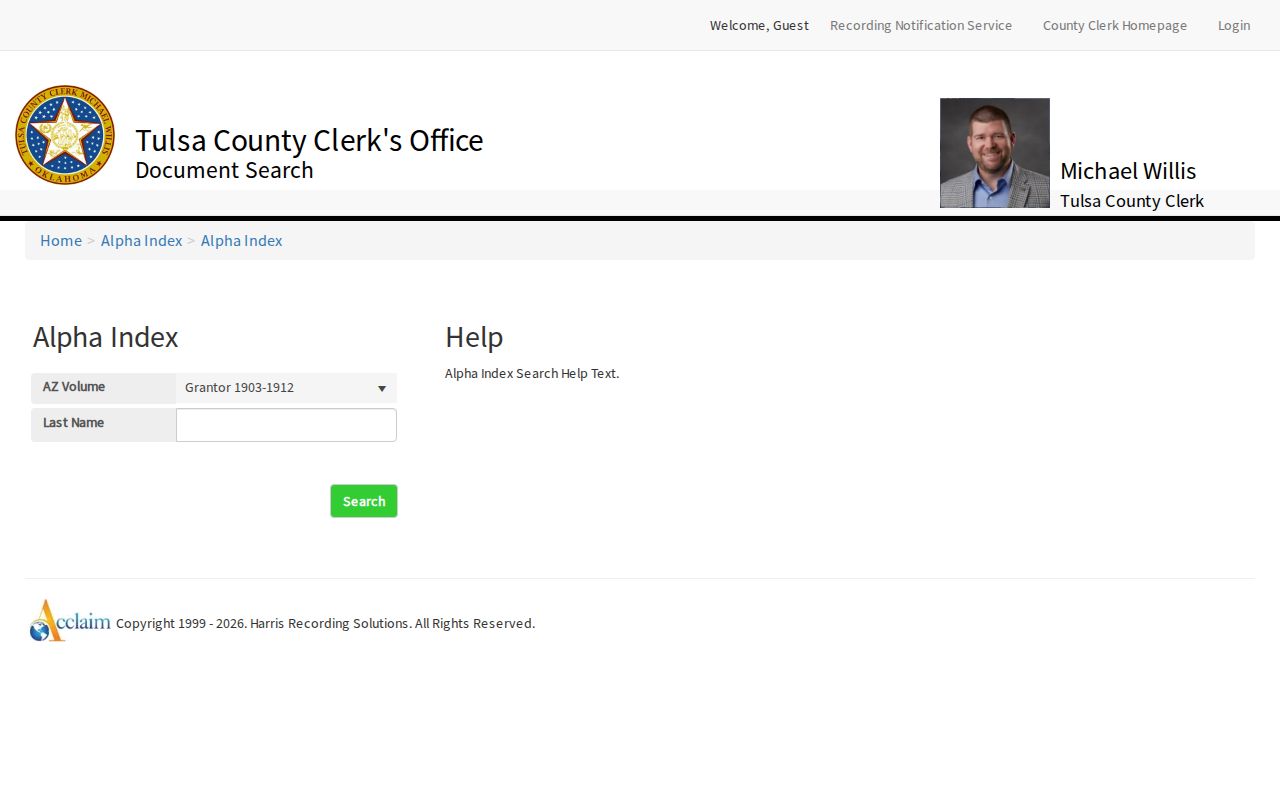 The index is a route into recorded land research, not a conclusion by itself. Record the document number, book and page, recording date, parties, and legal description from each verified transfer.
- Open the current parcel card and copy the parcel ID and legal description.
- Search the Clerk land records by legal description for the applicable online period, then by parcel, document, or date as needed.
- Read the purchase deed to identify the grantee and the grantor, meaning the buyer and seller in that transfer.
- Search the prior seller as a grantee to locate that person’s earlier purchase.
- Repeat backward and compare the legal description at every link before treating two documents as the same property.
Acclaim’s inner Jenks land-record search may require a local account or subscription. If access is unavailable or an early Jenks document is missing from the online product, move to the Clerk’s counter and public computers rather than accepting the gap as a final answer. The Clerk office is at 218 W. 6th St., seventh floor, Tulsa, and its listed phone is 918-596-5801. Ask which historical product corresponds to the Jenks parcel’s book, page, or tract reference in hand.
Jenks Previous Residents Have Cutoffs
INSIDER TIP: A missing Jenks online match may mean the wrong historical product, not a missing transfer. County and library research for Jenks identifies a name-index route from 1928 to current, legal-description searching from 1987 to current, book-and-page work for earlier material, and Digital Reel for pre-1928 Jenks research. The cutoffs describe portal and index coverage, not the beginning of ownership.
For a property that crosses those cutoffs, use the Clerk’s public-access computers and the historical tract or grantor-grantee indexes. The Tulsa County land-records research guide distinguishes the Assessor and Treasurer’s free access from Clerk subscription products and directs researchers to the older workflow. Bring the legal description, any book and page citation, and all spelling variants.
- Grantor and grantee
- The grantor transfers an interest in the property. The grantee receives it.
- Chain of title
- A sequence of recorded transfers tied to the same legal description. It should be verified document by document.
- Legal description
- The land description used in deeds and plats. It is more stable than a street number for older Jenks research.
- Track Index
- A subdivision-oriented land-research index that can lead to plat, book, page, or document references.
Jenks Previous Residents at TCCL
Tulsa City-County Library’s house and neighborhood history guidance gives a practical Jenks sequence: use the Track Index by subdivision, then the Tulsa Recorder database, then Digital Reel and tract-index material as the date requires. That sequence keeps a historical Jenks address attached to the lot, block, and recorded reference rather than assuming a modern street number appears unchanged in every source.
The TCCL house and neighborhood history guide shows the research path. 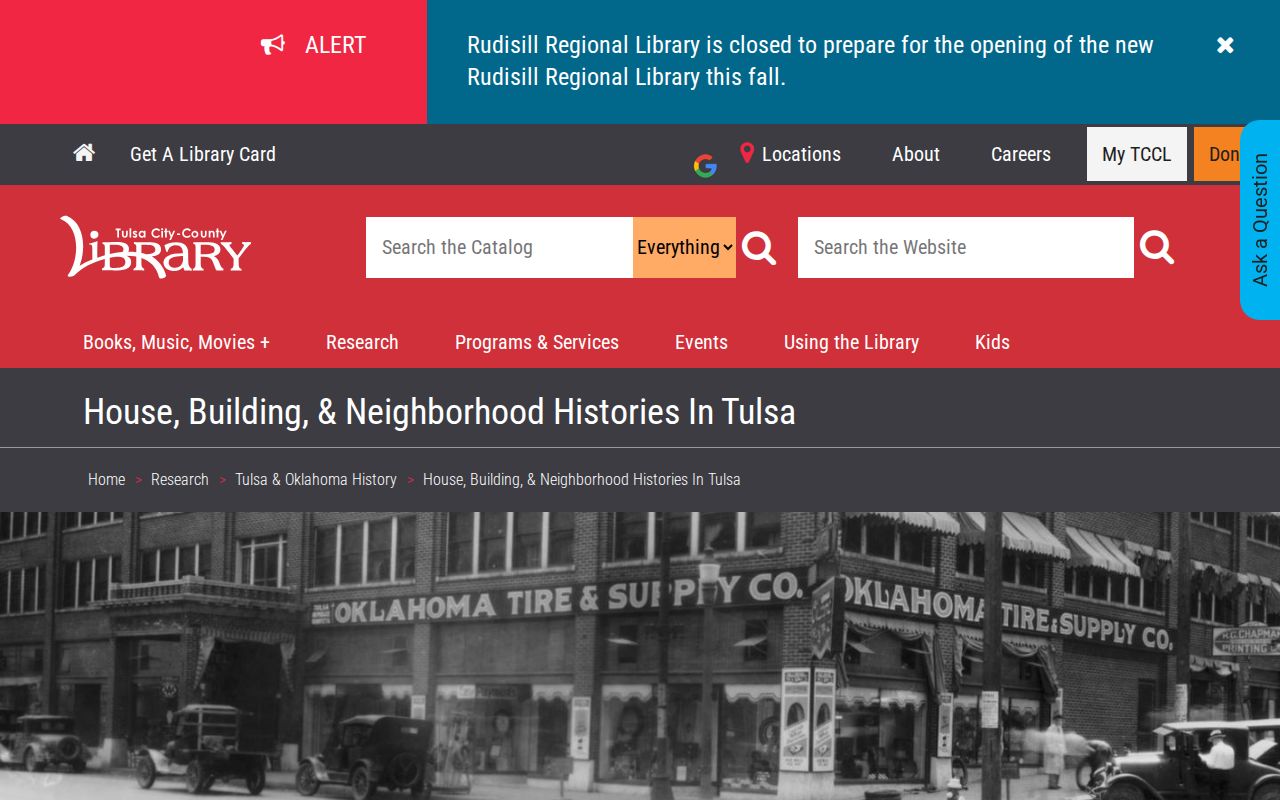 Public library and courthouse computers bridge the periods where a simple web query gives no answer.
The guide can also point toward plats and public land-record references. It does not establish that a particular person lived at the address, so pair each ownership clue with a dated household source.
Jenks Previous Residents in Directories
Jenks directories add the occupancy layer that deed records often lack. Tulsa City-County Library says reverse searching begins in 1912 because streets are arranged alphabetically. Locate the Jenks address in the street section, record the listed name, then use the name section for related details such as occupation or telephone listing when present. Telephone directories from 1931 forward can cover a wider area than city directories.
Selected Jenks-area Tulsa directories are accessible remotely for 1910, 1920, 1921, and 1922. The 1909-1935 run is available through Ancestry Library Edition at TCCL locations. A Jenks household may appear under Tulsa, Tulsa County, or another heading depending on the volume. The historical Jenks collections themselves are available through the Jenks city directory collections.
Do not claim a particular Jenks-only publisher run from the available research. The Oklahoma Historical Society’s city-and-year search and TCCL staff are the right routes when a volume is uncertain.
Pair Jenks Past Residents With Census
A dated Jenks address trail becomes stronger when the directory and census agree on people, place, and time. Federal census releases follow the 72-year pattern, with 1950 released in 2022. Tulsa City-County Library has Tulsa enumeration-district maps for 1910, 1920, 1930, and 1940. Because Jenks boundaries and nearby Jenks development changed, search Tulsa County, township, and adjacent address forms as well as Jenks.
- Record the directory year, exact street form, listed name, and any spouse or occupation note.
- Check the previous and following directory volumes for spelling, number, and household changes.
- Use the matching census year and the appropriate enumeration-district map to locate the area.
- Compare the household with the parcel legal description, deed trail, and later obituary or probate evidence.
Note: An address match across decades needs supporting land or family evidence because city labels and street forms can change.
Jenks Previous Residents at Endpoints
Jenks probate filings can connect a former owner to an estate representative, heirs, and a recorded conveyance. The Tulsa County Court Clerk keeps Jenks probate and court files, while OSCN or ODCR can point to a case docket. Court access rules still apply, and a docket does not replace the underlying file. Use probate as an estate and property trail, not as a shortcut to private household details.
For a death or family-history lead, Jenks America Museum identifies obituaries, death notices, memorials, and funeral cards as local leads. Oklahoma’s OK2Explore is a free birth and death index with age thresholds, while certificates remain eligibility-controlled. Verify a date, relationship, or address through the originating custodian, newspaper scan, library collection, or probate file.
Older local publication and biography indexes at Tulsa City-County Library are another fallback. Their indexed documents are read at the Research Center or requested through library staff. The Oklahoma Historical Society Research Center in Oklahoma City offers a catalog, newspaper and city-directory research, maps, manuscripts, and a reference route for material not exposed online. Exact Jenks newspaper runs and funeral-home archive coverage were not confirmed, so a lead must be checked with the holding institution.
Lawful Jenks House History
Previous residents research serves family history, estate work, local history, and informed property curiosity. It cannot reveal every occupant. Property records can omit renters and other household members, and utility, motor-vehicle, protected voter, sealed court, and restricted vital information remain outside a public address trail.
Jenks house history often crosses three labels: a Jenks street address, a Tulsa County Clerk record, and a Tulsa-area directory. Keep the Jenks parcel ID, Jenks legal description, date, and source together for each finding. That Jenks research log makes a later match reviewable and helps separate a documented past resident from a name that merely resembles a Jenks address result. A Jenks match is strongest when the Jenks deed, Jenks directory, and Jenks parcel agree on time and place.
Lawful use. Use Jenks address history for legitimate personal and historical research. Never use a record trail to follow, harass, intimidate, or harm a living person.